Smart Contract Engineering
Implement application rules with reviewed access controls and well-defined state changes.

Ethereum development for smart contracts, dApps, tokens and integrations. Design clear permissions, test critical flows and prepare your application for launch.
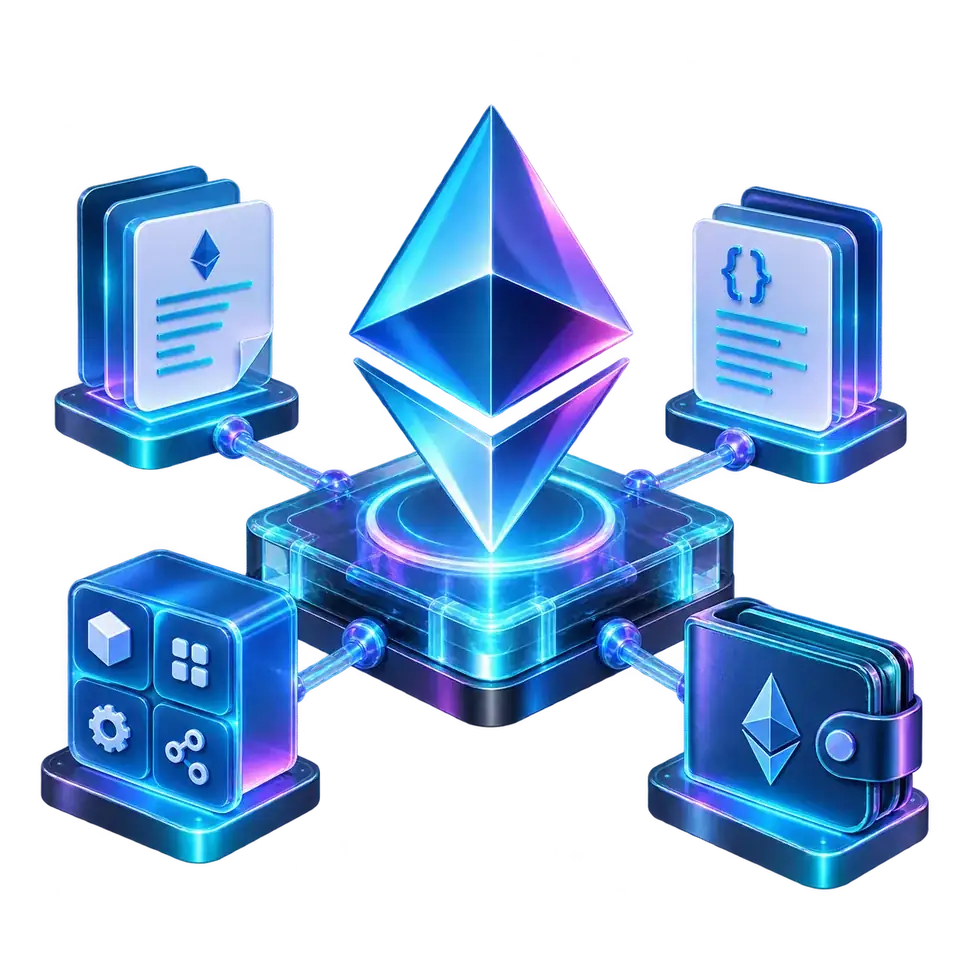
Implement application rules with reviewed access controls and well-defined state changes.
Connect contracts to responsive interfaces with understandable approvals and transaction status.
Use appropriate standards while documenting supply, transfer and administrative behavior.
Index events and connect blockchain activity with application APIs and business systems.
Evaluate whether a compatible scaling network fits the product and its operational requirements.
Prepare deployment artifacts, monitoring and a clear approach to contract upgrades or immutability.
We choose the implementation tools after confirming the architecture and integrations.
An Ethereum product needs more than deployed code. We plan who can act, what users authorize and how the application behaves when transactions fail or take time.
Separate user actions, operator roles and emergency capabilities.
Measure representative contract operations during testing.
Decide whether changeability is necessary and how it is governed.
Review wallets, RPC providers, indexing and oracle assumptions.
Represent supported assets and access rights with defined contract behavior.
Connect proposals and decisions to controlled execution.
Coordinate verifiable events with existing application workflows.
Build collectible, membership and content-access experiences.
Define product requirements and evaluate Ethereum or a suitable compatible network.
Specify contract behavior, roles, events and integration boundaries.
Develop contracts, user interfaces and supporting services in parallel workstreams.
Test authorization, edge cases, transaction costs and failure handling.
Deploy reviewed artifacts and hand over monitoring and maintenance documentation.
No. Many applications use contracts or existing assets without introducing a separate token. The product requirements should determine that choice.
That depends on their architecture. Immutable contracts and upgradeable contracts have different tradeoffs, which should be decided and documented before deployment.
Yes. We compare the application needs, ecosystem integrations, security assumptions and operating constraints rather than choose solely on advertised transaction costs.
Tell us what you want to build. We’ll help define the next practical step.